P.E. at St Mary's
Physical Education Mission Statement
At St Mary’s Catholic Primary School, our mission is to inspire every child to develop a lifelong love of physical activity and to recognise the important role that movement, sport and wellbeing play in living a happy, healthy and active life.
Rooted in our school mission to “Love God, love others and love ourselves,” our PE curriculum places the development of the whole child at its heart. We believe that every child can succeed in PE and are committed to providing an ambitious, inclusive and high-quality curriculum in which every pupil participates, progresses and experiences success.
Through carefully sequenced learning, children progressively develop their physical literacy, knowledge, skills and confidence. Prior learning is deliberately revisited and built upon so that pupils become increasingly competent, confident and independent in a broad range of physical activities.
Our teaching is ambitious for all. Learning is adapted appropriately so that every child, regardless of starting point, ability or additional need, is supported and challenged to achieve their personal best. Children are encouraged to take appropriate risks, persevere when something is difficult and recognise that improvement comes through practice, determination and resilience.
Beyond physical competence, PE at St Mary’s develops the values and behaviours that help our children flourish. Through sport and physical activity, pupils learn the importance of teamwork, respect, fairness, leadership, resilience and celebrating the achievements of others.
We want every child to leave St Mary’s seeing themselves as someone who can be active, can improve and can achieve. Our ultimate aim is not simply to develop successful performers, but to equip every pupil with the confidence, knowledge, skills and positive attitudes needed to enjoy physical activity and make healthy choices throughout their lives.

Movement and Physical Development
Fundamental Movement Skills
At St Mary’s Catholic Primary School, we recognise that fundamental movement skills are the building blocks of physical development and provide the foundations for confident participation in physical activity and sport.
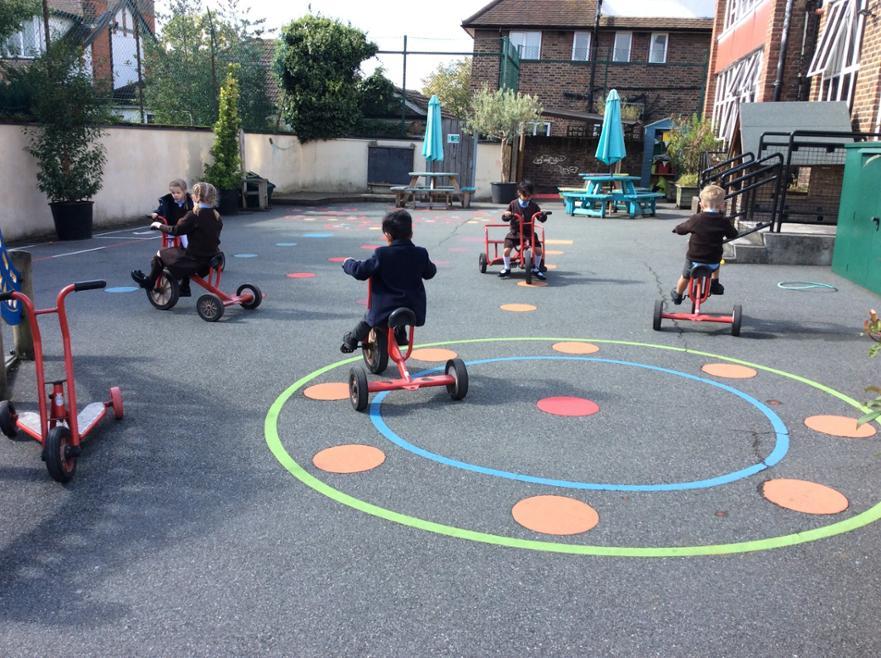
In the EYFS, children develop gross motor skills through active play and structured physical experiences, with a focus on strength, balance, coordination, spatial awareness and confident movement.
Building on these foundations, the Key Stage 1 National Curriculum requires pupils to develop fundamental movement skills and become increasingly competent and confident. Children develop and refine skills including running, jumping, hopping, skipping, throwing, catching and balancing, applying them individually, in combination and within simple games.
The ABCs of Physical Development
Our multi-skills approach develops:
Agility – changing direction and reacting with control.
Balance – maintaining stability when still and moving.
Coordination – moving different parts of the body effectively together.
Speed – moving and reacting quickly.
Core Strength – developing stability, posture and controlled movement.
Spatial Awareness – moving safely in relation to people, objects and space.
Sending and Receiving
Children develop skills in throwing, catching, rolling, kicking, striking and controlling objects with increasing accuracy. These provide the foundations for a wide range of sports and physical activities.
From Skills to Games
As pupils progress, the emphasis moves from acquiring and mastering fundamental movement skills to applying and refining them. Children begin to understand space, possession, attacking and defending in KS1 before progressing to increasingly complex skills, tactics and strategies in KS2.
Our progression is:
EYFS: Gross motor development and physical confidence
KS1: Fundamental movement skills and simple tactics
Lower KS2: Applying and combining skills within games
Upper KS2: Refining skills and applying tactics and strategies independently
Through our PE curriculum, children learn to participate, practise, persevere and progress, developing the competence, confidence and enjoyment needed to lead healthy, active lives.
PE Progression
EYFS & KS1 – Fundamental Movement Skills
EYFS – Explore and Develop
Children develop confidence in moving their bodies and begin to master the fundamental movements needed for future physical activity.
Pupils will learn to:
- Run, stop and change direction safely.
- Jump and land with increasing control.
- Hop, skip and balance.
- Move confidently in different ways and directions.
- Develop spatial awareness.
- Roll, throw and kick towards a target.
- Catch and receive larger objects.
- Develop hand-eye and foot-eye coordination.
- Participate positively in simple games.
- Follow basic rules and instructions.
Key focus: Explore • Confidence • Movement • Coordination
Year 1 – Build and Practise
Children develop greater control of fundamental movement skills and begin to combine movements.
Pupils will learn to:
- Run at different speeds and change direction with control.
- Jump, hop and skip with increasing fluency.
- Balance in different positions.
- Throw and roll with increasing accuracy.
- Catch with two hands.
- Kick and control a ball.
- Move safely into and around space.
- Combine simple movements.
- Participate in partner and small-group games.
- Understand simple rules and demonstrate fair play.
Key focus: Control • Balance • Agility • Coordination
Year 2 – Master and Apply
Children become increasingly competent in fundamental movement skills and begin applying them within simple game situations.
Pupils will learn to:
- Move with increasing speed, agility and control.
- Combine running, jumping, hopping and skipping fluently.
- Send and receive objects with greater accuracy.
- Pass and receive using hands and feet.
- Move into space to receive an object.
- Begin to avoid or move around opponents.
- Apply skills within simple competitive games.
- Begin to make decisions during play.
- Work effectively with teammates.
- Understand the difference between attacking and defending.
Key focus: Fluency • Accuracy • Application • Teamwork

|
EYFS and KS1 collection of skills | [pdf 27MB] |

|
KS2 – Invasion Games: Skills & Strategies
Year 3 – Introduce
Children apply their fundamental movement skills to structured invasion games and develop an understanding of attacking and defending.
Pupils will learn to:
- Pass and receive accurately while stationary and moving.
- Develop dribbling and ball-control skills.
- Move into space to support teammates.
- Maintain possession with support.
- Begin to mark an opponent.
- Recognise when their team is attacking or defending.
- Apply simple tactics in small-sided games.
- Communicate and cooperate as part of a team.
Key focus: Possession • Space • Support • Marking
Year 4 – Develop
Children develop greater control and begin making purposeful decisions during competitive situations.
Pupils will learn to:
- Pass, receive and dribble with increasing accuracy and control.
- Select appropriate methods of passing.
- Create and use space effectively.
- Support the player in possession.
- Mark and track opponents.
- Intercept passes.
- Transition between attacking and defending.
- Apply simple team strategies.
- Explain how tactics can improve performance.
Key focus: Decision-making • Movement • Interception • Tactics
Year 5 – Apply
Children apply skills with increasing fluency and make tactical decisions in more challenging game situations.
Pupils will learn to:
- Perform skills accurately under pressure.
- Select the most appropriate pass or movement.
- Create space for themselves and others.
- Maintain possession as a team.
- Develop attacking strategies to create scoring opportunities.
- Defend effectively individually and as a team.
- Anticipate opponents' movements.
- Adapt tactics in response to the opposition.
- Take on leadership and officiating roles.
- Evaluate their own and others' performance.
Key focus: Pressure • Strategy • Anticipation • Leadership
Year 6 – Master, Adapt and Evaluate
Children confidently apply and adapt skills, strategies and tactics within increasingly competitive situations.
Pupils will learn to:
- Perform a broad range of skills fluently and consistently.
- Make quick and effective decisions under pressure.
- Create, exploit and defend space.
- Use attacking formations and strategies effectively.
- Work collectively to regain possession.
- Adapt tactics during a game.
- Recognise strengths and weaknesses in opposition.
- Communicate effectively and lead others.
- Officiate games fairly and confidently.
- Analyse performance and identify ways to improve.
Key focus: Fluency • Tactical Awareness • Adaptability • Leadership