Attendance and Punctuality
At St Mary’s Catholic Primary School, we believe that excellent attendance and punctuality are essential to every child's education, wellbeing and future success. Every school day matters. Regular attendance enables children to benefit fully from teaching and learning, develop positive relationships, participate in the wider life of the school and make sustained academic progress.
As a Catholic school, we believe that every child is a precious and unique gift from God and that belonging to our school community is an important part of their development. We want St Mary’s to be a calm, orderly, safe and supportive environment where children are keen and ready to learn.
Our Attendance Culture
Improving attendance is everyone's responsibility. School leaders, teachers, support staff, governors, pupils and parents/carers all have an important role to play in promoting excellent attendance.
We will:
Promote the benefits of regular attendance through our whole-school culture.
Set high expectations for attendance and punctuality.
Build strong and trusting relationships with pupils and families.
Work collaboratively with parents/carers to understand and remove barriers to attendance.
Monitor attendance carefully and identify pupils or groups who may require additional support.
Respond early when attendance begins to decline rather than waiting until absence becomes persistent.
Work with appropriate external agencies where additional support is required.
Recognise and celebrate good and improved attendance.
Ensure that attendance is considered alongside safeguarding, behaviour, SEND, pastoral support, mental health and wellbeing.
Legal Expectations
The law entitles every child of compulsory school age to a full-time education suitable to their age, aptitude and any special educational needs they may have.
Where parents/carers choose to register their child at a school, they have a legal responsibility to ensure that their child attends that school regularly. This means that children are expected to attend every day that the school is open unless:
they are too unwell to attend;
the absence is for another legally permitted reason; or
the school has authorised the absence in advance.
The school is required by law to maintain an admission register and attendance register and to accurately record pupils' attendance and absence.
Term-Time Leave
There are 190 school days (380 sessions) in each school year. This leaves 175 days when schools are normally closed, providing families with substantial opportunity to arrange holidays and other activities outside term time.
The school strongly encourages parents/carers to arrange family holidays and other activities during school holidays wherever possible.
Parents/carers may request a leave of absence during term time. However, leave of absence will only be granted where the school considers that the circumstances are exceptional, in accordance with the Department for Education's statutory guidance.
Each request will be considered individually on its merits. The school will not operate a blanket policy that automatically grants or refuses leave of absence.
A family holiday during term time will not normally constitute an exceptional circumstance.
Parents/carers should not make arrangements to take their child out of school before a request for leave has been considered and permission granted.
Where a pupil is absent without the school's authorisation, the absence will be recorded as unauthorised. Where appropriate, the school may work with the Local Authority and consider legal intervention in accordance with statutory guidance.
Why Attendance Matters
Regular attendance gives children the best opportunity to:
Achieve academically – missing school means missing teaching, explanation, practice and opportunities to develop knowledge and skills.
Build positive relationships – regular attendance enables children to develop and maintain friendships and strong relationships with staff.
Support their wellbeing – consistent routines and belonging to the school community help children feel secure, connected and supported.
Access the full curriculum – children who attend regularly can fully participate in lessons, enrichment, trips, clubs and wider school life.
Develop personal responsibility – attendance and punctuality help children understand the importance of commitment, reliability and making the most of opportunities.
Prepare for the future – good attendance habits provide an important foundation for secondary school, further education, employment and adult life.
Support safeguarding – regular attendance is an important protective factor. Being in school gives staff opportunities to identify concerns at an early stage and ensure children receive appropriate support.
Supporting Families
We recognise that barriers to attendance can be wide-ranging and individual to each child and family. We will seek to understand the circumstances behind absence and work in partnership with pupils and parents/carers to identify appropriate solutions.
Where attendance becomes a concern, the school will provide appropriate support and may involve other professionals or services where necessary.
Our approach is supportive, consistent and proportionate. We will combine high expectations with practical support, recognising that securing good attendance is most effective when schools and families work together.
Personal Responsibility
At St Mary’s, we believe that regular attendance is also an important part of developing personal responsibility.
We want children to understand that attending school regularly, arriving on time, being prepared to learn and making the most of each day are important habits for life. We recognise that circumstances can sometimes make attendance difficult and will provide appropriate support, but we also maintain high expectations and encourage children, as they grow, to take increasing responsibility for their attendance, punctuality and readiness to learn.
Every school day matters. Every lesson matters. Every child matters.

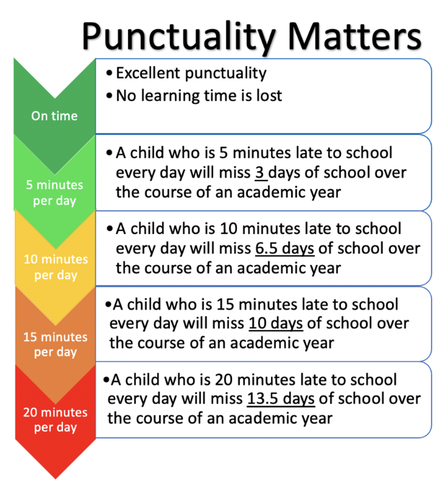
Regular school attendance is essential for every child’s learning, confidence, and social development. When children attend school every day and arrive on time, they are better able to keep up with lessons, build friendships, and develop positive routines. We expect all pupils to maintain attendance above 97%; children whose attendance falls below this level will be closely monitored and families may be invited into school for meetings to discuss support and improvement plans. Punctuality is also very important, as arriving late can disrupt learning and cause children to miss valuable teaching time at the start of the day.